Why Business Growth Feels Harder Than Ever (And What Actually Works Now)

If you’ve been running a business for more than a few years, you’ve probably noticed something that’s awkward to say out loud.
Business growth feels harder.
Not “I’m tired” harder. Not “this quarter is rough” harder. Fundamentally harder.
You can be disciplined. You can do the reading. You can track the metrics, ship content, refine your offers, attend the right events, and still feel like you’re pushing against a wall that refuses to move. Ten years ago, effort felt like it had a visible return. You leaned in, things bent. Slowly, sure, but predictably.
Now it feels like the equation broke.
This isn’t a motivational problem. It’s not a mindset gap. And it’s definitely not because you suddenly forgot how to work hard.
The environment changed. Quietly. Systemically. And most people are still trying to win by rules that no longer exist.
Why Business Growth Feels Harder in Today’s Environment
For a long time, we were taught a simple story:
Work harder.
Learn more.
Apply best practices.
Growth follows.
That story used to be mostly true. Or at least true enough to keep people motivated.
Today, business growth feels harder because effort no longer correlates cleanly with progress. You can do more and still get the same result. Or worse, burn out faster while revenue stays flat.
Here’s what changed underneath the surface:
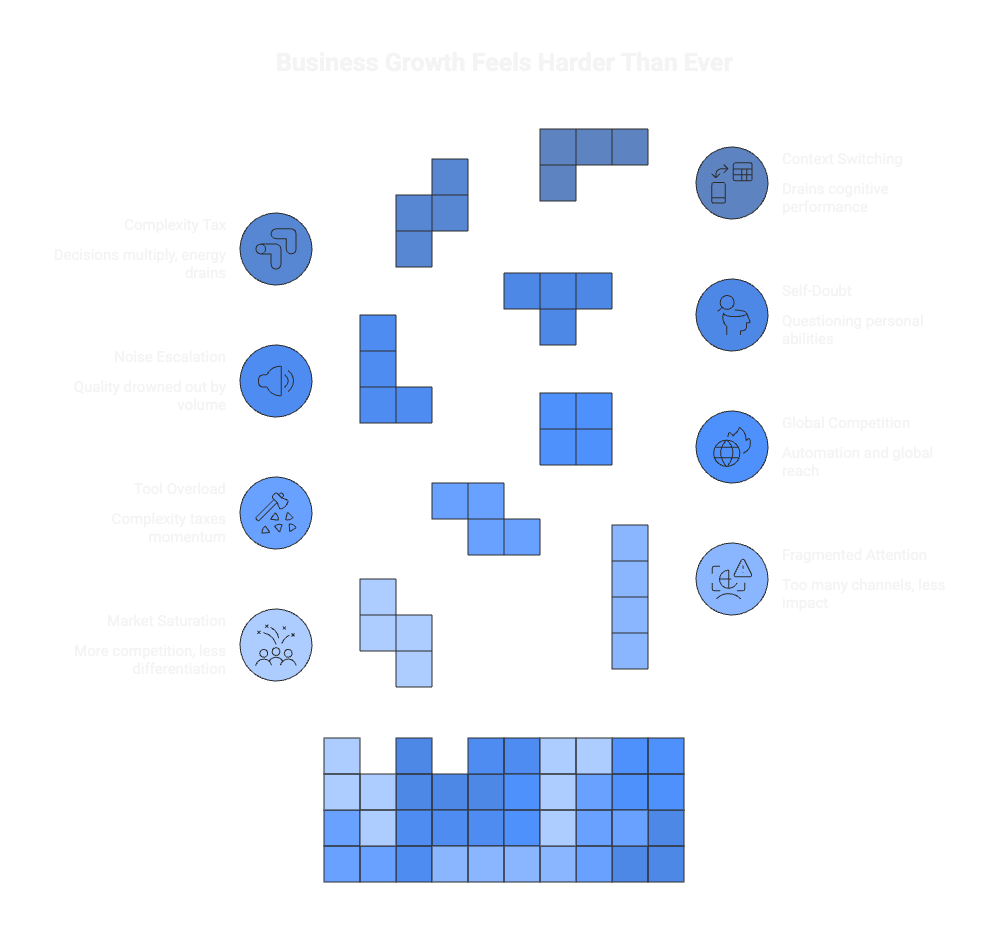
- Markets are more saturated than ever
- Attention is fragmented across too many channels
- Tools multiplied faster than clarity
- Competition is no longer local, it’s global and automated
- Noise now scales faster than quality
None of that shows up on a productivity dashboard. But you feel it every day.
And when effort stops working the way it used to, the brain does something dangerous. It turns inward.
The Psychological Cost When Business Growth Feels Harder
When growth stalls, most people don’t question the system first. They question themselves.
- “Maybe I’m missing something obvious.”
- “Maybe I don’t want it badly enough anymore.”
- “Maybe I lost my edge.”
- “Maybe everyone else figured it out and I didn’t.”
That self-doubt creeps in slowly. Not as panic, but as background static. And the longer it sits there, the more it rewrites your confidence.
This is where the myth of hustle becomes corrosive.
Hustle culture trained us to treat friction as a personal failure. If you’re stuck, you must not be grinding hard enough. If growth feels harder, you must be doing something wrong.
But what if the friction isn’t internal?
What if it’s environmental?
How Complexity Made Business Growth Feel Harder Than It Should Be
On paper, modern businesses have more leverage than ever.
More tools.
More data.
More platforms.
More automation.
In reality, complexity has become a tax on momentum.
Each tool works fine on its own. The problem is what happens when they stack.
- Slack messages that turn into emails
- Emails that turn into meetings
- Meetings that turn into follow-ups
- Follow-ups that never ship anything
You don’t feel lazy. You feel busy. Constantly context switching. Constantly reacting. Constantly “on.”
Business growth feels harder because:
- Simple tasks now cross multiple systems
- Decisions multiply instead of collapsing
- Mental energy gets drained before real work starts
- Progress is buried under coordination overhead
You’re not running out of effort. You’re running out of clarity bandwidth. Modern business doesn’t just suffer from bad strategy, it suffers from information overload and decision fatigue, which research has shown can actively reduce productivity and judgment quality.
Why More Tools Made Business Growth Feel Harder, Not Easier
There was a window where adding tools actually created leverage. That window closed quietly.
Now, adding another platform often does this instead:
- Increases surface area for distraction
- Adds another place things can break
- Creates new metrics that demand attention
- Requires ongoing maintenance just to stay “optimized”
It’s like strapping a jet engine to a car while leaving the parking brake on. The power is there, but it’s fighting against drag you can’t see.
That’s why business growth feels harder even when you’re “doing everything right.” You’re carrying invisible weight. The hidden cost of modern tool stacks is constant interruption, because context switching quietly drains cognitive performance, even when the work itself seems manageable:
Why Simplicity Is the Only Real Advantage Left
Here’s the uncomfortable truth.
The businesses that are growing right now are not hustling harder than everyone else. They’re less busy.
Not lazy. Not checked out. Just ruthless about subtraction.
They win by:
- Making fewer decisions
- Saying no more often than yes
- Removing steps instead of adding optimizations
- Designing systems that eliminate work, not multiply it
Simplicity isn’t minimalism for aesthetics. It’s structural sanity.
Simplifying your systems also means optimizing customer experiences, as explained in Streamlining the Buyer’s Journey: Turning Your Website into Your Top Salesperson, a guide on transforming your website from noise into conversion clarity.
When business growth feels harder, simplicity becomes a force multiplier. This is why organizations that reduce complexity consistently outperform their peers, especially in volatile environments where clarity matters more than speed:
How Structure Makes Business Growth Feel Possible Again
Structure is not rigidity. It’s relief.
Good structure does three things:
- It reduces decision fatigue
- It limits distraction by design
- It makes progress visible again
Instead of asking “What should I focus on today?” every morning, the answer is already embedded in the system.
That’s why structure beats motivation.
Motivation is unreliable. Structure doesn’t care how you feel.
A great example of turning clarity into growth is our article: Boost Your Online Sales with the Power of Social Proof, where social proof strategies are broken down into actionable design and content elements.
And when structure replaces chaos, business growth stops feeling like a daily wrestling match. Structure works because it reduces the number of daily micro-decisions, and decision fatigue is a measurable cognitive drain, not a motivational failure.
Why Trying Harder Is the Wrong Response When Business Growth Feels Harder
When something stops working, the instinct is to push harder.
That instinct made sense when effort reliably paid off.
Now it backfires.
Trying harder in a broken system just creates faster burnout. You pour more energy into activities that no longer scale.
The people who “figure it out” don’t outwork everyone else. They stop confusing activity with progress.
They:
- Reduce inputs before chasing outputs
- Collapse workflows instead of expanding them
- Question assumptions before adding effort
- Remove noise before seeking growth
That’s not laziness. That’s strategic restraint.
Feeling Stuck Is Feedback, Not Failure
This part matters.
Feeling stuck does not mean you’re bad at business.
It means the rules changed and no one handed you the new playbook.
Growth environments evolve. Systems ossify. Tools pile up. Incentives drift. At some point, pushing harder stops working and clarity becomes the scarce resource.
When business growth feels harder, the signal isn’t “try more.”
The signal is “rethink the game.”
The Old Growth Rules vs the New Reality
Old rules rewarded:
- Volume
- Hustle
- Being everywhere
- Doing more than competitors
New reality rewards:
- Focus
- Constraint
- Clear positioning
- Fewer, higher-impact moves
The trap is assuming the old rules still apply. That’s where most frustration lives.
Where Real Business Growth Starts Now
Progress doesn’t start with another tool.
It doesn’t start with another hack.
It doesn’t start with more effort.
It starts with naming what’s actually holding you back.
- Where complexity crept in
- Where decisions multiplied unnecessarily
- Where noise replaced leverage
- Where systems stopped serving outcomes
Once you see that clearly, the path forward usually gets boring.
And boring is good.
Boring scales. Boring compounds. Boring works.
That’s the quiet truth underneath why business growth feels harder today. Not because you’re failing, but because the game rewards different skills now.
Clarity over chaos.
Structure over hustle.
Simplicity over noise.
Everything else is just distraction wearing productivity cosplay.
Recent Articles

January 21, 2026
January 11, 2026

April 12, 2025
Free SEO eBook
Download our comprehensive guide to mastering SEO in 2026
" " indicates required fields